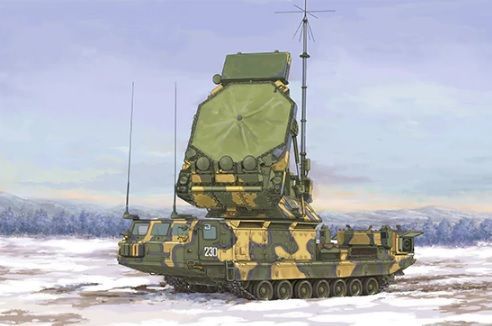
The 9S32 Grill-Skovoroda radar is the designation of a soviet, and now russian, mobile radar system designed primarily for tracking air targets during the Cold War and the present. At the risk of being inaccurate, it can be assumed that the production of these radar systems began in the early 1980s, and the first units entered service with the soviet Army in 1983, although they reached full operational capability around 1988-1989. The 9S32 Grill-Skovoroda radar is designed for the S-300V anti-aircraft missile system (NATO code: SA-12 Gladiator). The presented system is a multi-band radar designed primarily for targeting targets: both aircraft and short- and medium-range ballistic missiles. It is assumed that the radar can simultaneously track 6 targets and target 6 of its own missiles. In the 9S32-1 version, the detection range of a target the size of a jet aircraft is 150 kilometers, while in the 9S32M version the detection range is 200 km, while the system can detect a target the size of a ballistic missile from a distance of 120-140 km, and a target the size of a fighter jet from 140 kilometers.
The S-300 (NATO reporting name: SA-10 Grumble) is a soviet, and currently russian, surface-to-air and ballistic anti-ballistic missile defense system. Design work on this system probably began in 1967, but production only began in 1975, probably continuing intermittently until 2011. In the case of early versions of the S-300P system, the projectile (effector) is, for example, the 5W55R, with a range of 75 kilometers, a maximum ceiling of 25,000 meters, and the mass of the warhead does not exceed 133 kilograms.