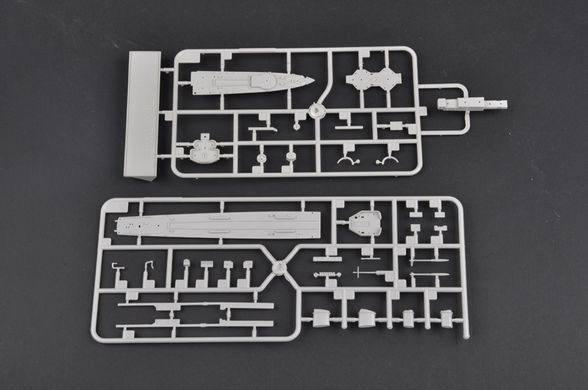
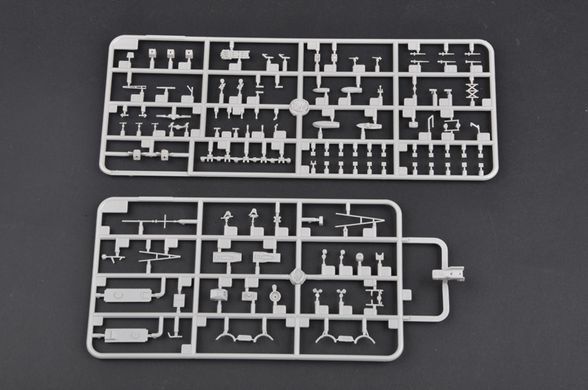
Z30 was a German destroyer, the keel of which was laid down in 1940 and launched in December 1940. The destroyer entered the service of the German Navy (German Kriegsmarine) in November 1941. The ship had a length of 127 meters, a beam of 12 meters and a full displacement of 3,600 tons. The maximum speed of the destroyer Z30 was 36 knots. The main armament at the time of launch was 5 150-mm guns in two twin and one single-tower turret, and the auxiliary armament: 4 37-mm guns, 5 20-mm guns and 8 533-mm torpedo tubes and mines.
Z30 was the eighth ship of the Narvik class or 1936A. These types of destroyers were a continuation of the Type 1936 destroyers. The main changes were to strengthen the armament and replace the main artillery from 127 mm guns with 150 mm guns. There were also some improvements in running characteristics and a slightly increased cruising range. The result was a series of large destroyers that, under favorable conditions, could engage Allied light cruisers or French large destroyers. Since entering service (November 1941), the destroyer Z30 served in the North Sea and the North Atlantic, and in December 1942 fought with convoy JW51B, and also took a minor part in the Battle of the Barents Sea on 31 December 1942. After this battle, she continued to serve in Norway, from a base in Altenfjord, as part of the 4th Flotilla. In September 1943, it took part in the capture of Spitsbergen. It was withdrawn from Norway in mid-1944. It survived the war and was handed over to the British, who sold it for scrap in 1948.