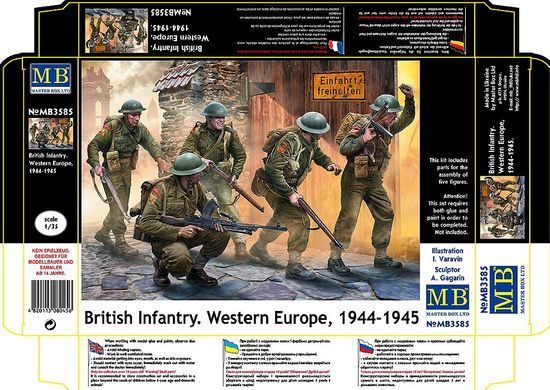
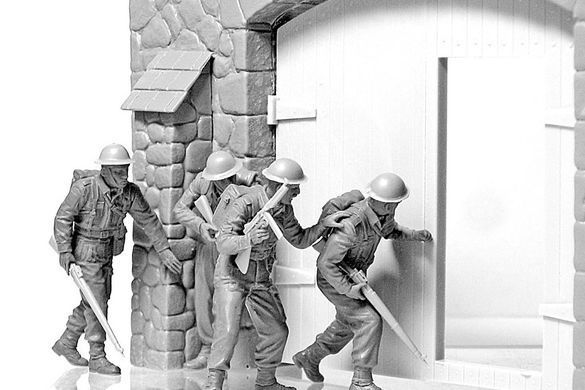
During the Second World War, the British Army formed a total of 43 infantry divisions. At the start of the war, a division had approximately 13,800 officers and men, while by 1944 this number had increased to approximately 18,300. This significant change in personnel was due mainly to an increase in the number of various types of support units, rather than an increase in the number of infantrymen themselves. In 1944, a British infantry division consisted of three infantry brigades, each with its own headquarters, headquarters platoon, 3 infantry battalions and engineer divisions. It is worth adding that one infantry battalion had approximately 780 officers and men and numerous support units (such as a mortar platoon or reconnaissance platoon). The division also included an actual artillery brigade with five artillery regiments (including one anti-tank and one anti-aircraft), a machine gun and mortar battalion, as well as reconnaissance, signal and sapper units. An important element in increasing the mobility of the British infantry division was its full motorization. The main rifle of the British infantryman was the Lee Enfield No. 1 or No. 4 rifle. As machine guns, among others, Sten submachine guns, Bren light machine guns and Vickers machine guns were used. The most common anti-tank weapons were 40 mm and 57 mm 2- and 6-pounder guns, and later also 76 mm 17-pounder guns. In turn, the main armament of the field artillery was the very successful Ordnance QF 25-pounder howitzer.