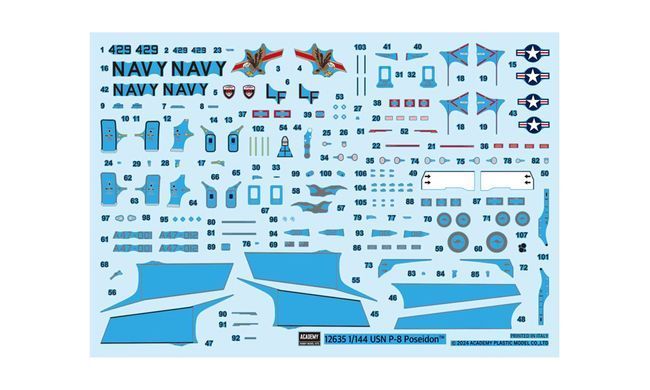
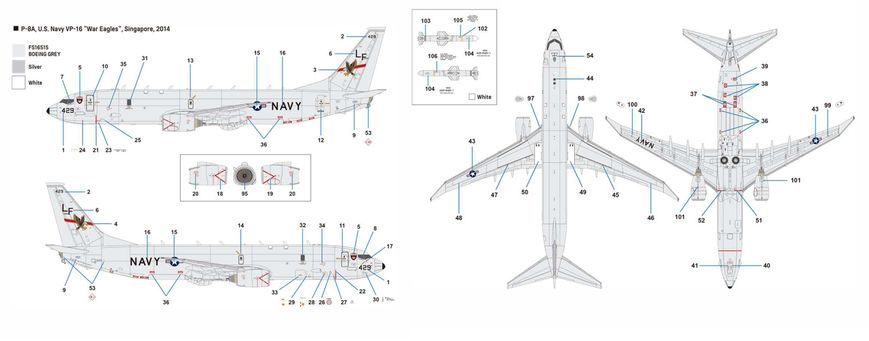
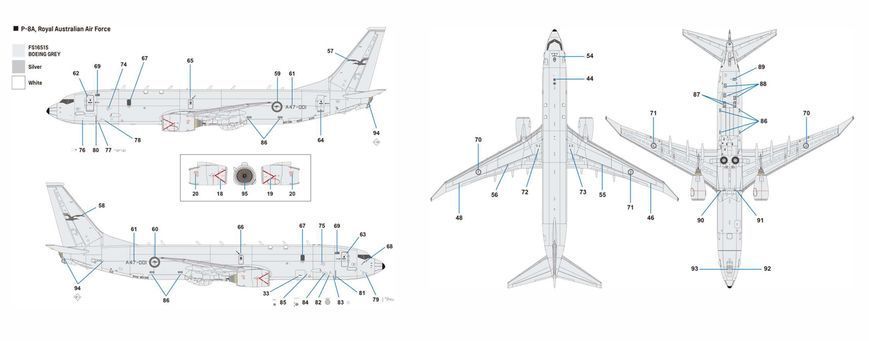
The Boeing P-8 Poseidon is a US naval reconnaissance and anti-submarine warfare (ASW) and surface-to-surface anti-submarine warfare (SWAT) aircraft. It first flew in 2009 and entered service in 2013. Approximately 80 of these aircraft have been built to date. The aircraft is 39.47 meters long, has a wingspan of 37.64 meters, and is 12.83 meters high. It is powered by two CFM International CFM56-7B27A turbofan engines with 121 kN thrust each. It has a cruising speed of approximately 815 km/h and a maximum range of approximately 8,300 kilometers. The aircraft has five inner pylons and six outer pylons, on which it can carry a wide range of naval weapons.
The aircraft was originally developed for the US Navy to replace the aging Lockheed P-3 Orion aircraft. After the failure of the program to find a successor to the British Nimrod aircraft, the UK also expressed interest in the program. To reduce research work and reduce the risk of failure, Boeing decided to use the proven civilian Bo-737 as a platform for the new machine. In the end, a successful and modern maritime reconnaissance and air aircraft was created with extensive electronic equipment - primarily the Raytheon APY-10 multi-purpose radar station - and advanced communications equipment, including satellite communications. Interest in the Boeing P-8 Poseidon aircraft, or orders for it, was shown by such countries as Australia, India, New Zealand and South Korea, in addition to the USA and the UK.