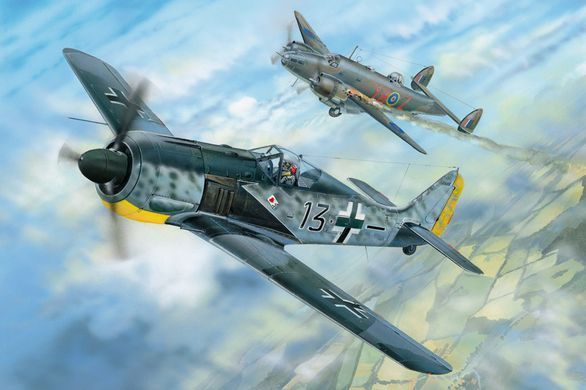
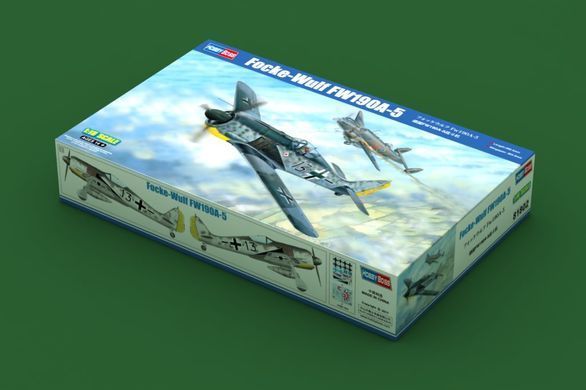
The Focke-Wulf Fw-190 was a German single-engine, all-metal fighter with a covered cockpit in a low-wing design of the Second World War. Pilots considered the Fw-190 to be a better aircraft than the Messerschmitt Bf-109. The free-standing, low-wing, working canopy Fw-190 was ordered by the Luftfahrtministerium and assembled in the fall of 1937. Kurt Tank presented two proposals for power plants - the first with a liquid-cooled Daimler-Benz DB 601 engine, and the second with a new BMW 139 radial engine. The latter was chosen, and work began in the spring of 1938 under the leadership of Obering. R. Blaser. The first prototype of the Fw-190V1 was ready in May 1939, and on June 1, 1939, Captain Hans Sander took it into the air in Bremen. The second prototype, the FW-190V2, armed with two MG131 and two 7.92 mm MG17 machine guns, flew in October 1939. To reduce aerodynamic drag, both were fitted with a tunnel air intake in the propeller hood, but problems with engine overheating led to a return to the proven NACA shield design. Before these prototypes could finally be tested, the decision had already been made to replace the BMW 139 engine with the more powerful but longer and heavier BMW 810. This required a number of changes, strengthening the structure and moving the cockpit back, which later became a source of problems with the center of gravity. The advantage was the elimination of problems with exhaust gas permeability and overheating of the cabin due to its close proximity to the BMW 139 engine. The third and fourth prototypes were abandoned, and the Fw-190V5 with a new engine was initially completed in 1940. It later received wings with a one-meter increased span (from the original 9.5 m), which made it 10 km/h slower, but increased the rate of climb and improved maneuverability. It was designated Fw-190V5g, and the variant with a shorter wing was designated Fw-190V5k. The first seven machines of the Fw-190A-0 information series had a short wing, the rest had a longer one. The first operational unit equipped with the Fw-190 - 6./JG 26, stationed in Le Bourget, declared its operational readiness in August 1941, and from the first meeting of the new fighter with the British Supermarine Spitfire, its superiority over them became obvious. During the war, about a dozen modifications of this aircraft were created. The machines of the "A" version, along with a dozen or so upgrades, served as fighters. The versions marked "B" and "C" were only prototypes of high-altitude fighters designed to combat strategic bombers, but did not enter serial production. The "D" variant, as the only one of the Fw-190s, was equipped with a new Jumo 213A engine with a capacity of 1750 hp and was the German answer to the P-51 Mustang. The new engine lengthened the fuselage by several tens of centimeters. This variant also performed mainly hunting and high-altitude fighter missions. Numerous variants of the F version were used as fighter-bombers for close support on the battlefield. The "G" version played the same role as the "F" version, but had a greater range. Over 20,000 copies of this one of the best fighters of World War II were produced throughout the war. Technical data (variant Fw-190A-8): length: 9 m, wingspan: 10.51 m, height: 3.95 m, maximum speed: 656 km/h, rate of climb: 15 m/s, maximum range: 800 km, maximum ceiling 1 13 mm MG131 machine gun and 4 20 mm MG151 cannons (2 MG 151/20E cannons for the D-9 version).