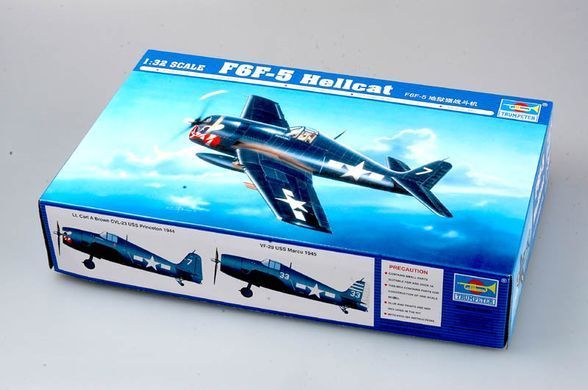
The Grumman F6 Hellcat was an American single-engine, semi-submersible fighter of World War II with a low-wing design. The F6 Hellcat was developed as a development of the successful F4F design. Its design was based on 18 months of F4F service in the Pacific and extensive feedback from pilots who had flown Wildcats. Structurally, the F6 Hellcat was similar to its predecessor with one significant change. It used a low-wing system that allowed the landing gear to be stowed in the lower center wing rather than the fuselage. This increased the track width and ground stability. In addition, the cockpit was armored and the ammunition was increased. The United States Navy's evaluation of Grumman's proposal led to an order in June 1941 for four prototypes—XF6F-1 through XF6F-4—each with a different powerplant. The XF6F-1 flew a year after the contract was signed, but due to the urgent need to strengthen the Wildcats (F4F), the same airframe was fitted with the most powerful Pratt-Whitney R-2800-10 engines available, which enabled the aircraft to make its next maiden flight, this time as the XF6F-3. Even before this second flight took place, Grumman had been instructed to introduce the F6F-3 into production as the Hellcat. At this stage, the similarities between the F4F and the F6F reduced the time required to introduce the machine into series production. The first such machine flew in late 1942, and deliveries to the USS Essex began in January 1943. In August of that year, VF-5 from the USS Yorktown was the first to use their Hellcats against the Japanese. The aircraft's structure was made entirely of metal, riveted together, and the wings were folded with tips to facilitate hangaring on the deck of aircraft carriers. Standard armament consisted of six 12.7 mm machine guns mounted in the nose of the wing. The fuselage and tail unit had a classic design, differing from the F4F only in size. The three-legged landing gear was fully retracted using a hydraulic system, as was the hook to reduce landing divergence. The spacious cockpit was raised high above the wing plane. Production of all versions of the F6 exceeded 12,200 copies, and its intensity was so high that it was possible to very quickly replace the F4Fs that were still in use. Technical data (for the F6F-5 version): Maximum speed: 620 km/h, rate of climb: 14 m/s, practical ceiling 11,400 m, maximum flight range: 1,755 km, armament: stationary - six 12.7 mm Browning machine guns. Suspended - up to 1,800 kg of bombs or an additional fuel tank.