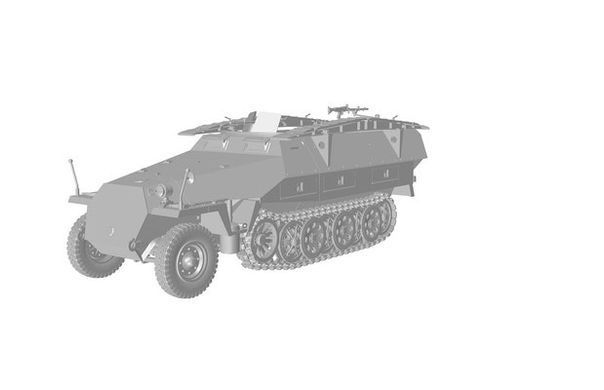
The Sd.Kfz 251 was a German medium half-track armored personnel carrier of World War II. The first prototypes of the vehicle were manufactured in 1935, and serial production continued from 1939 to 1945, with approximately 14,500 units produced. The Sd.Kfz 251 was powered by a 100 hp Maybach HL 42 TURKM six-cylinder engine.
The Sd.Kfz 251 was designed as a new, basic half-track armored personnel carrier for the German armed forces. Its design was based on the Sd.Kfz.11 heavy tractor, with several changes to the adapted chassis: a new fuel tank was added, the steering wheel was positioned, and the exhaust system was redesigned. During the mass production process, four basic versions of the Sd.Kfz 251 (Ausf. A, B, C and D) were created, however, in terms of details related to the production process (especially version C) and a slightly different arrangement of elements inside the fuselage. During World War II, more than 20 variants and versions of the Sd.Kfz 251 were created. The chronological first was the Sd.Kfz 251/1, which was the basic version armed with two MG34 or MG42 machine guns and capable of carrying up to 10 paratroopers. In 1941, the Sd.Kfz 251/2 version was developed, armed with an 80 mm mortar. There was also the Sd.Kfz 251/3 version, which was a communications and radio communication vehicle with various sets of radio stations and antennas. In 1942, the Sd.Kfz 251/9 Stummel variant was developed, armed with a 75 mm StuK 37 short-barreled gun. More interesting versions were the Sd.Kfz 251/16 with two flamethrowers or the Sd.Kfz 251/20 UHU, equipped with an infrared emitter and designed for target designation at night. Sd.Kfz 251 vehicles of all versions served mainly in armored divisions and armored grenadier units on almost all fronts of World War II: from the September Campaign (1939), through the campaign in France (1940), hostilities in the Balkans and North Africa (1941-1943) after the battles on the Eastern (1941-1945) and Western (1944-1945) fronts.