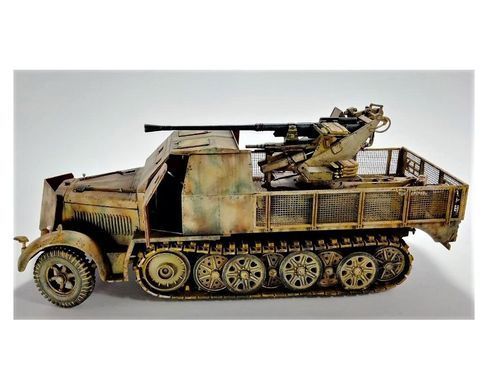
Sd.Kfz. 7 (German: Sonderkraftfahrzeug 7) was a German half-track transporter of the Second World War. The first prototypes were built in 1933, and serial production continued in 1934-1945, ending with the release of about 12,000 copies of this machine. The drive was provided by a single Maybach HL 62TUK or Maybach HL 64TR engine with a capacity of 140 hp. Sd.Kfz. 7 did not have stationary weapons as standard.
The first models of the future Sd.Kfz. 7 were built in 1928 at the Krauss-Maffei company in Munich, but the machine did not enter serial production at that time, as it violated the provisions of the Treaty of Versailles. Only after the Nazis came to power in Germany were the technical solutions of the previous models finalized, and the machine was relatively quickly launched into mass production. The Sd.Kfz. 7 was capable of carrying up to 12 soldiers and had a minimum armor of no more than 8 mm. Despite weighing up to 10 tons, the vehicle had good off-road performance and high mobility. It was also mechanically refined and was not unreliable. In the German armed forces, it served as an artillery tractor for guns with a caliber of 37 to 88 mm. These vehicles were also used to tow 150 mm sFH18 howitzers. Several specialized versions were created on the basis of the Sd.Kfz. 7, including: Sd.Kfz. 7/1 (20 mm self-propelled anti-aircraft gun), Sd.Kfz. 7/2 (also a self-propelled anti-aircraft gun, but with a caliber of 37 mm) or Sd.Kfz. 7/5 (a version that is a self-propelled anti-tank gun with a caliber of 75 mm). Vehicles of this type were used on all fronts of World War II between 1939 and 1945, by both the Wehrmacht and the Luftwaffe. Small numbers of Sd.Kfz. 7s served in Brazil, Bulgaria and Italy.