The main drawback of the LWS was its lack of armor protection, a feature considered essential for any amphibious vehicle. However, as a floating pontoon bridge unit, it was deemed too cumbersome. Consequently, the new design retained the basic structure of the LWS but utilized the running gear of the widely deployed Panzer IV tank, incorporating a lightly armored upper hull. Two prototypes, designated *Panzerfaehre* (or PzF), were developed to transport tanks or other supplies between floating docks as part of large pontoon bridge systems. Interesting features of this design included a centrally located deck winch and folding air intakes. The driver was positioned forward of the air intakes in the front section of the hull. In effect, the PzF was conceived more as a pontoon bridge unit than as a prime mover. However, after the construction of two prototypes and a series of trials, the project was cancelled in 1942. The seven LWS II units that had already been manufactured were deployed to the Eastern Front. After the war, the LWS II units were transported to Britain for technical evaluation.
Model dimensions: Length: 249.9 mm; Width: 91.2 mm
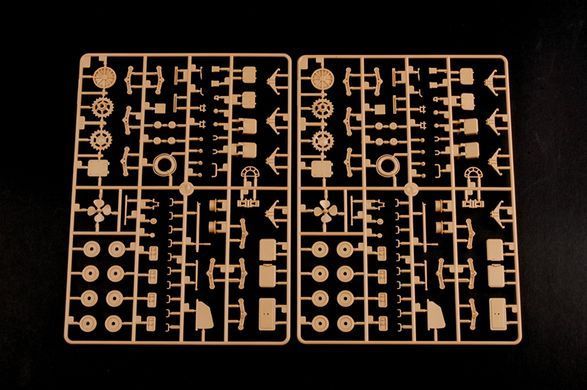
Total parts count: 280+