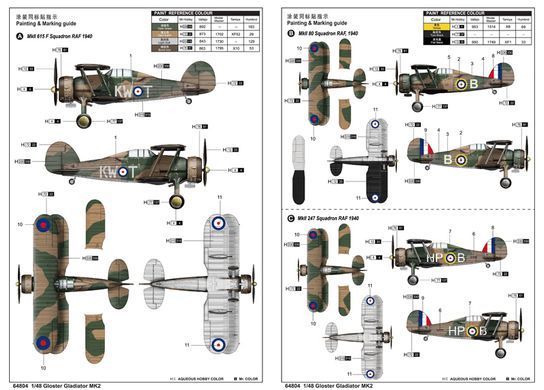
The Gloster Gladiator was a British all-metal biplane fighter of the early years of World War II. The prototype first flew in 1934 and entered production in 1937. Depending on the version, the aircraft were powered by Bristol Mercury Mk IX (Gladiator Mk.I) or Bristol Mercury Mk VIIIA (Gladiator Mk.II and Sea Gladiator) engines. A total of 747 Gloster Gladiators were built. During World War II, aircraft of this type saw action in Norway (263 Squadron), France (607 and 615 Squadrons), and in North Africa and the Middle East (33, 80, 94 and 112 Squadrons). Interestingly, only one squadron equipped with Gladiators (247th) participated in the Battle of Britain in 1940. The aircraft is most famous for its heroic defense of Malta in June 1940 against superior Italian forces. Despite its high quality design and durability, the Gladiator was reassigned to training and meteorological units after 1940. The Gladiator remained in service until 1953, when it was finally retired by the Portuguese Air Force. Technical data (Mk.I version): length: 8.36 m, wingspan: 9.83 m, height: 3.58 m, maximum speed: 407 km/h, rate of climb: 11.7 m/s, maximum flight range: 708 km, maximum ceiling 1000 m, armament: stationary – 4 Vickers machine guns of 7.7 mm caliber.